Is The Sinking City 2 Open World? Exploring Drowned Arkham's Level Design
Wondering if The Sinking City 2 is open world? Discover how Frogwares is replacing the sprawling map of the original game with a dense, semi-open survival horror experience.
The Big Question: Has the Open World Been Left Behind?
A recent thread on the game’s subreddit asked a question that has been on the minds of many returning fans: “I really enjoyed Sinking City 1. Is it true that Sinking City 2 isn’t open world?” It is a completely valid concern and a critical topic of discussion within the community. The 2019 original was heavily marketed on the back of its massive, ambitious recreation of Oakmont. Players could spend hours merely wandering the streets, discovering side cases, fighting the occasional creature, and soaking in the grim atmosphere of a sprawling city slowly succumbing to a supernatural flood.
However, as we look toward the August 18, 2026 release of the sequel on PC, PlayStation 5, and Xbox Series X|S, the landscape of the franchise has shifted dramatically. Frogwares has explicitly confirmed that this new installment represents a hard pivot into the pure survival horror genre. With that shift comes a necessary sacrifice: the traditional, seamless open-world structure is reportedly being left behind in favor of a much tighter, semi-open design. For players worried about losing the freedom of the first game, it is vital to understand why this architectural change was made and how it ultimately serves to create a far more terrifying Lovecraftian experience in the drowned city of Arkham.
The Pacing Problem of Massive Maps
To fully grasp the new direction, we must look at the inherent tension between open-world design and survival horror. In an open-world game, the player fundamentally controls the pacing. If an area is too dangerous, you can simply walk away. If you are running low on supplies, you can spend hours grinding in low-risk neighborhoods to hoard ammunition and medical kits. While this level of freedom feels incredibly rewarding in an RPG or a traditional detective game, it acts as poison to the carefully curated dread required for effective horror.
In the 2019 game, Oakmont was vast, but its sheer size meant that many streets were essentially empty space, acting merely as transit zones between points of interest. Procedurally generated interiors and repeated assets were a necessity to fill the immense landmass. By contrast, true terror requires a feeling of claustrophobia, isolation, and a distinct lack of control. When Frogwares decided to make a true survival horror experience, they recognized that a sprawling, unrestricted map would undermine the tension they were trying to build. You cannot foster a sense of relentless dread if the player has the freedom to jog three blocks away to a designated safe zone whenever things get tough.
Drowned Arkham: A Masterclass in Semi-Open Hubs
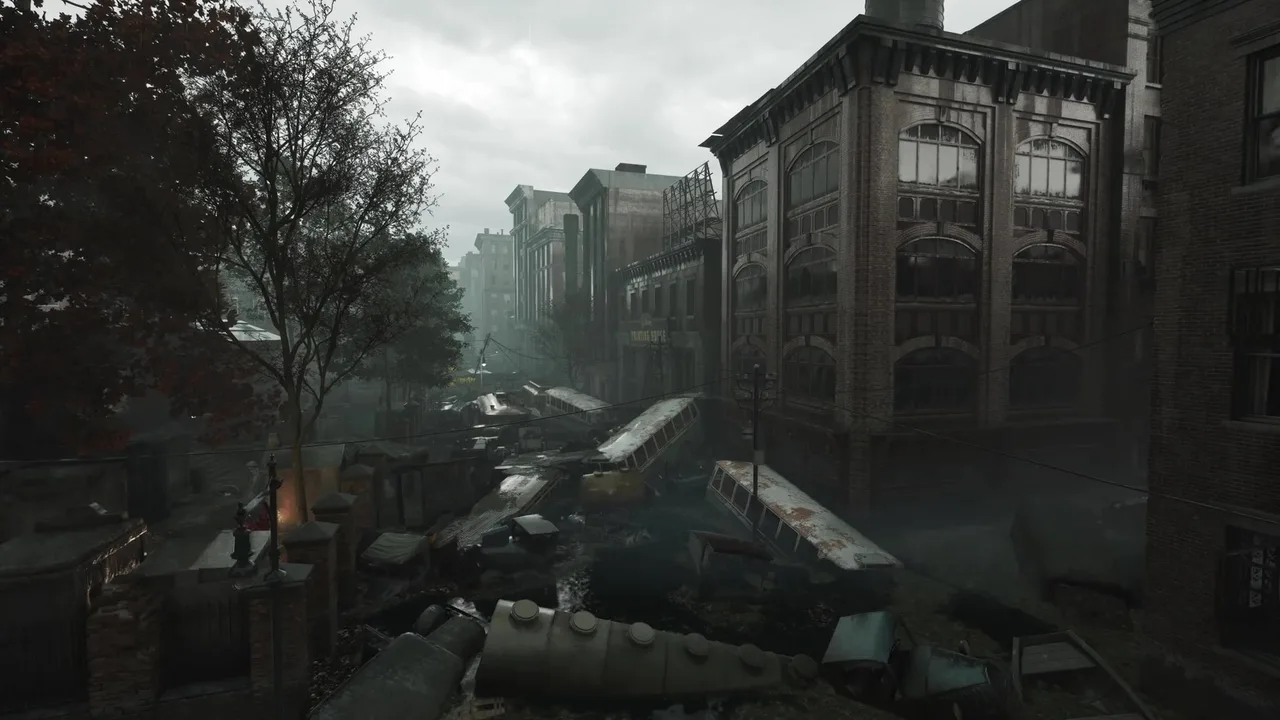
Instead of a single, continuous landmass, the sequel is expected to feature a semi-open, interconnected hub structure. Think of the critically acclaimed level designs found in modern survival horror masterpieces, where locations are massive, multi-tiered puzzles in their own right. The ruined streets of Arkham are not just a backdrop; they are a hostile, shifting environment designed to trap and disorient the player at every turn.
Recent community-shared screenshots from the PC demo—aptly titled “Waters Rising” by virtual photographers on Reddit—highlight the staggering visual fidelity made possible by Unreal Engine 5. Because the developers no longer have to render miles of empty streets, every single room, alleyway, and flooded basement is uniquely bespoke. The environmental storytelling is incredibly dense. A location like downtown Arkham is reportedly built as an intricate labyrinth of waterlogged avenues, collapsed gothic architecture, and precarious upper-floor pathways. It is not an open world in the traditional sense, but rather a deeply layered sandbox of terror where every unlocked door or drained corridor feels like a monumental, hard-fought achievement.
The Return to Meaningful Backtracking
If you cannot just walk in any direction for an hour, how does exploration function in this new iteration? The answer lies in Metroidvania-style progression. In a semi-open hub, you will frequently encounter blocked paths, chained iron gates, or flooded stairwells that cannot be traversed upon your first visit. Exploration becomes a deliberate, highly rewarding loop of scouting a hostile area, securing a key item or tool, and then surviving the harrowing trek back to unlock a new pathway.
This structure inherently forces players to backtrack through familiar territory, which is a cornerstone of top-tier horror design. A hallway that was safe ten minutes ago might not be safe when you return. The shadows might have shifted, or a new eldritch threat might have pulled itself from the rising black waters. This makes navigation a constant mental strain, demanding that you memorize the layout of the environment while dealing with the psychological weight of the returning sanity mechanics. The tension never truly dissipates; it merely changes form as you push deeper into the city.
Navigating the Flood with Purpose
The transition away from an open world also drastically alters the primary method of transportation. In the original game, piloting your small vessel was a relatively tranquil, if occasionally tedious, way to get from one flooded district to another. In the sequel, boat and navigation mechanics are expected to be far more localized and fraught with immediate peril.
The waterways of Arkham are tight, choked with floating debris, and heavily shrouded in supernatural fog. You are not charting a leisurely course across a vast lake; you are slowly, agonizingly maneuvering through a flooded residential block, constantly checking your blind spots. In these claustrophobic channels, encountering aquatic monstrosities becomes a terrifying prospect. When a creature like the Slither makes its presence known in a narrow alley where your boat barely fits, the tension is unparalleled. There is no open water to flee into—you must deal with the threat using whatever meager tools you have on hand, or desperately seek dry land before your vessel is destroyed.
Resource Scarcity in a Contained Environment
Perhaps the most significant benefit of the hub-based design is the absolute control it gives the developers over the game’s brutal economy. Survival horror lives and dies on its resource mechanics. Tighter level design means that the placement of every single bullet, bandage, and crafting component is a deliberate choice made by the designers, rather than a random spawn point on a sprawling map.
When managing your resource and inventory, you are engaging with a finely tuned system. The developers know exactly how many supplies you could have possibly scavenged before locking you into a boss encounter or throwing you into a gauntlet of Deep Ones. This curated approach ensures that you are constantly kept on the ragged edge of survival. You will rarely feel entirely safe, and you will never feel like you have enough firepower to comfortably clear a room. In an open-world setting with respawning loot, achieving this delicate balance of empowerment and vulnerability is nearly impossible.
A Necessary Evolution for the Franchise
Returning to the question posed by fans: yes, it appears that the sprawling, free-roaming map of Oakmont is a thing of the past. For players who exclusively loved the 2019 game for its boundless detective wandering, this might initially feel like a tough pill to swallow. However, for anyone craving a genuinely terrifying, atmospheric experience that respects the source material, this structural change is the best news possible.
By condensing the map into highly detailed, semi-open hubs, Frogwares is prioritizing quality and curated tension over sheer scale. The flooded streets of Arkham promise to be denser, scarier, and far more memorable than anything we have seen from the studio before. The shift away from the open-world formula is not a downgrade by any metric; it is a necessary evolution to ensure that when The Sinking City 2 launches, it stands as an uncompromising, premier survival horror experience.