The Submerged Quarter
Drowned Beyond Recovery
The Submerged Quarter in The Sinking City 2 — Arkham's fully underwater streets where Deep Ones rule and the pressure never lets up.
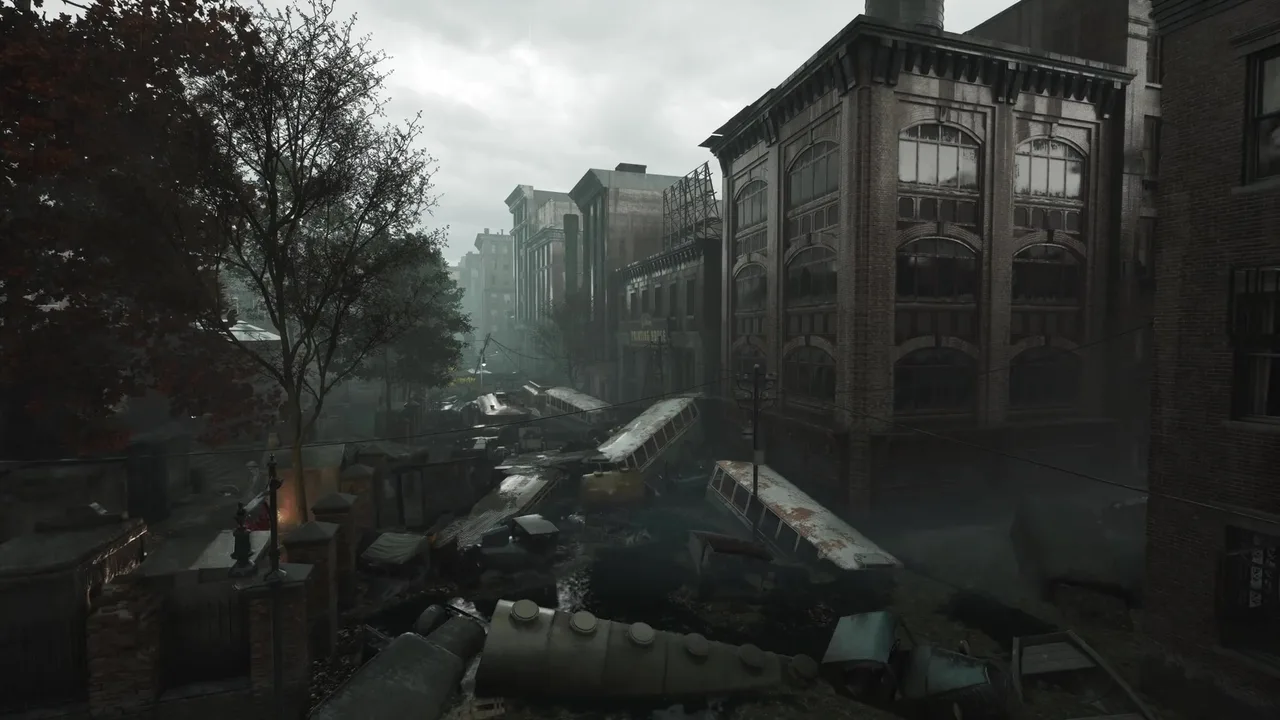
Below the waterline, you stop being an investigator. You're prey.
Some parts of Arkham flooded. The Submerged Quarter drowned.
This isn’t a district with water in the streets. This is a district where the streets are water — ten, fifteen, twenty feet of dark, cold, supernaturally altered ocean sitting where a neighborhood used to be. Rooftops are the new ground level. Church steeples poke up like periscopes. Everything else is below, and below is where the Deep Ones live.
You’re not supposed to be here. The game knows it, the creatures know it, and after thirty seconds underwater, you’ll know it too.
Below the Surface
The Submerged Quarter occupies what we’d expect to be Arkham’s lowest-lying area — the flats near the river, perhaps, or a depression in the town’s geography that collected the floodwater like a bowl. Whatever the cause, the water here is deep enough that surface exploration is barely possible. A few rooftops and upper-story windows break the surface, offering tiny islands of air and solid footing, but the district’s content is overwhelmingly below the waterline.
Underwater, the streetscape is eerily preserved. The flood rose fast and relatively gently — it didn’t smash buildings so much as fill them. You swim down past second-story windows into living rooms still furnished, past shop fronts with their signs still readable, down streets where lampposts still stand upright in the silt. The geometry of a normal town, rendered in aquatic stillness. Fish drift through intersections. Seaweed colonizes awnings.
It would be almost beautiful if something enormous weren’t watching you from behind every other building.
Visibility is the defining constraint. Arkham’s floodwater isn’t clear ocean. It’s murky, particulate-heavy, tinted a sickly green-brown. Your effective sightline is maybe fifteen feet on a good stretch, less in disturbed water. You navigate by landmarks — the distinctive facade of a bank, a church’s pointed arch, a street sign still bolted to its post — because your map is functionally useless when every reference point is submerged.
Oxygen and Pressure
Frogwares hasn’t detailed the exact underwater mechanics, but based on the demo’s treatment of water as a hazard, we’d expect an oxygen system of some kind. A breath timer, a dive gauge, something that makes every second underwater feel borrowed.
Air pockets exist — trapped in sealed rooms, under overturned boats, in the upper corners of flooded buildings where physics created small bubbles of breathable space. Finding and memorizing these becomes a survival skill. You’ll plot routes between air pockets the way you plot routes between safe rooms in other survival horror games.
The pressure is psychological as well as literal. Underwater environments in games compress the player’s awareness. You’re watching your oxygen, watching for threats, watching your surroundings for navigation cues, all simultaneously, all on a timer. The Submerged Quarter is expected to be The Sinking City 2’s highest-stress zone for sustained play, not because every moment contains a monster, but because every moment might.
Deep One Territory
This is where the Deep Ones are fastest, most aggressive, and most numerous. You’re in their habitat. The speed disadvantage you can exploit on dry ground — luring them onto shallow surfaces where they’re clumsy — doesn’t exist here. They move through the water like they were born in it. Because they were.
Encounters here are likely ambush-heavy and multi-directional. A Deep One can come from below, from behind a building, from inside a flooded room you just swam past. The limited visibility means they’re on top of you before you register the movement, and underwater combat — assuming the game supports it — probably penalizes your weapon accuracy and movement speed.
Avoidance might be the better strategy. Stealth over confrontation. Swim quietly, use buildings as cover, move through interiors where the Deep Ones’ size might limit their pursuit. If the investigation system lets you find lore about Deep One patrol patterns, that knowledge could be worth more than ammunition down here.
Nesting grounds are rumored to exist in the Quarter’s deeper zones — structures the Deep Ones have claimed and modified, potentially decorated with the coral-and-bone aesthetic that Lovecraft described. These would be among the game’s most dangerous locations and potentially the source of its best underwater lore.
What’s Down There
The Submerged Quarter holds things that exist nowhere else. The logic is simple: nobody else can get to them. Scavengers picked over the Harbor. Survivors looted downtown. But the fully submerged district has been inaccessible to anyone without the equipment and the nerve to dive, which means its resources are untouched.
Expect rare crafting materials, unique upgrade components, and ammunition types you can’t find on the surface. The risk-reward math is deliberately punishing — the best gear in the game may require you to survive the worst environment in the game.
Investigation-critical lore is the other draw. Whatever happened in the Submerged Quarter before the flood — whoever lived here, what they saw, what they tried to warn people about — is preserved underwater in a way that surface districts aren’t. Water sealed these spaces from looting and decay. Documents in waterproof containers, objects too heavy to float away, structural clues embedded in the architecture. The investigation system may require you to dive repeatedly, piecing together a picture that no surface-level clue can complete.
Navigation Without a Map
You orient by architecture. That church steeple you can see from the surface becomes your north star. The bank’s distinctive colonnade marks the main intersection. You learn the district the way divers learn a reef — by shapes and spatial relationships, not street names.
The boat navigation guide probably covers surface approaches to the Quarter — where to anchor, which rooftops offer the best entry points — but once you’re underwater, you’re on your own sense of direction. Getting lost here is terrifyingly easy. Every flooded street looks similar. Every building facade blurs into the next one in the murky water. And the longer you’re down, the lower your oxygen, the worse your judgment.
A practical tip: before you dive, pick a visible landmark above the waterline and memorize its position relative to your entry point. When you’re disoriented underwater, swim up. The surface is always up. Finding your boat is the hard part.
Why You’d Come Here
Not because you want to. Because the game demands it.
The Submerged Quarter gates some of the investigation’s most critical revelations behind its drowning-depth difficulty. The rarest resources hide in the deepest places. Arkham’s secret — why the flood happened, what it’s still doing, who or what is responsible — has roots that run below the waterline, literally and figuratively.
Come prepared. Come with full oxygen, full health, fire-based throwables for the Deep Ones, and a clear mental image of where you’re going and how you’re getting back. The Quarter doesn’t forgive improvisation.
And come knowing that the moment you drop below the surface, the rules change. Up there, you’re an investigator. Down here, you’re a diver in a dead city, and everything in the water is faster than you.