Eldritch Horrors & Bosses
Cosmic Nightmares
A speculative overview of boss-tier cosmic horrors expected in The Sinking City 2. What Lovecraftian nightmares might await at the end of Arkham?
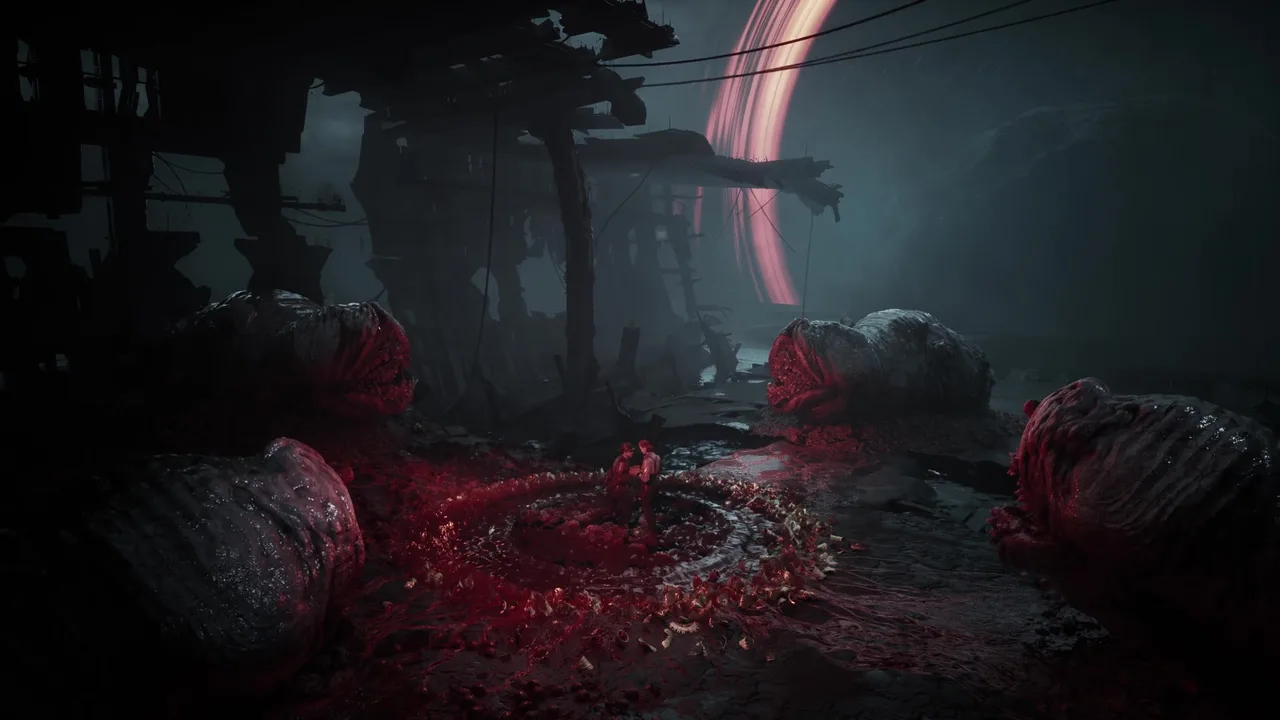
You don't kill something like that. You survive it. Maybe. If it lets you.
Speculative entry. Frogwares has not revealed specific boss encounters for The Sinking City 2. This entry covers what we can reasonably expect based on the game’s Lovecraftian setting, the developer’s track record, and the survival horror genre’s traditions. No specific boss names, phases, or mechanics are confirmed. This is our best-guess overview of what’s waiting at the bottom of Arkham’s food chain — or rather, at the top.
Every survival horror game has a hierarchy, and the things at the top of TSC2’s hierarchy won’t be anything you’ve seen before.
Lore
Lovecraft’s cosmic horror operates on a simple, devastating principle: humanity is insignificant. The universe contains entities so vast, so alien, and so fundamentally incomprehensible that encountering one isn’t a fight — it’s a reckoning. TSC2’s bosses will draw from this tradition, and the flooded Arkham setting gives Frogwares a rich canvas to work with.
The key art tells us something. Tentacles wreathing the skyline. The suggestion of massive organic forms beneath the water. Whatever caused Arkham’s flood wasn’t natural, and the source of that cataclysm is almost certainly something you’ll confront — or at least glimpse — before the credits roll.
Candidates from the Lovecraftian pantheon include Dagon (the ancient god of the Deep Ones, associated with ocean depths and maritime worship), Cthulhu (whose sunken city of R’lyeh echoes TSC2’s drowned Arkham), Hydra (Dagon’s consort), or a Shoggoth (a formless, protoplasmic horror used as a living engine by elder races). Frogwares might also create original entities specific to TSC2’s narrative — the first game mixed established Lovecraft lore with original creations, and that approach gives them more creative freedom.
The important distinction: these aren’t just big enemies. A boss-tier eldritch horror is conceptually different from a large Deep One. Deep Ones are biological creatures you can understand, even if they’re terrifying. A cosmic horror is something your mind wasn’t built to process. The sanity system exists, in part, to mechanically represent what happens when you’re forced to look at something that shouldn’t exist.
What to expect
Boss encounters in survival horror rarely follow the same rules as regular combat. Expect unique mechanics — patterns to learn, environmental elements to exploit, phases that change the fight’s dynamics. A straightforward “empty your magazine into the weak point” approach probably won’t work, or at least won’t be the intended approach.
Multi-phase fights
Most boss encounters in the genre use phases. Phase one teaches you the mechanic. Phase two adds complexity. Phase three tests whether you actually learned. For TSC2, these phases might correspond to escalating levels of eldritch revelation — the boss becomes more alien, more incomprehensible, and more dangerous as the fight progresses. Your sanity takes increasing pressure with each phase.
Environmental interaction
Arkham’s flooded environments offer natural boss-fight architecture. Rising water levels that change the arena mid-fight. Structural collapses that open or close pathways. Electrical hazards from submerged wiring. A boss fight set in a partially flooded cathedral, where the water rises with each phase and the architecture shifts under eldritch influence, writes itself.
Frogwares’ background in detective games suggests they might weave puzzle elements into boss encounters too. Rather than just shooting, you might need to interact with the environment in specific ways — activating machinery, redirecting water flow, using the investigation system to identify a vulnerability that isn’t obvious from just looking at the creature.
Sanity as a mechanic
Boss encounters will almost certainly push your sanity hard. The visual distortions, the hallucinated threats, the unreliable perception — all of these become exponentially more dangerous during a high-stakes fight. Managing your sanity during a boss encounter might be as important as managing your health and ammunition.
A boss that actively attacks your sanity — forcing you to question whether the attacks you’re seeing are real, whether the weak point you think you’ve identified is actually there — would be a uniquely Lovecraftian design decision. You’re not just fighting a monster. You’re fighting your own deteriorating grip on reality.
Scale beyond survival
Some bosses might not be “beatable” in the traditional sense. Lovecraftian horror includes entities you can’t kill — you can only survive the encounter, drive them away temporarily, or escape while they’re focused on something else. TSC2 might include encounters where the win condition isn’t “reduce health to zero” but “survive long enough,” “complete an objective while the boss is active,” or “seal it away using a ritual the investigation system uncovered.”
This would be narratively honest. You’re a detective in a trench coat with a revolver. You are not equipped to kill a god. But you might be clever enough, desperate enough, and lucky enough to make it through the night.
How to prepare
Without confirmed mechanics, preparation advice is necessarily general — but the principles are universal for survival horror boss encounters.
Stock up before you go in. If the game’s pacing is good, you’ll sense a boss encounter coming — a long quiet stretch, an unusual abundance of supplies, a save point in an ominous location. Don’t enter a boss arena with half a magazine and no healing items. Scavenge everything.
Diversify your loadout. Bring your best firearm, but also bring throwables, light sources, and healing. Boss fights tend to demand flexibility — a single weapon type won’t cover every phase.
Stabilize your sanity. If there are consumables or mechanics that restore sanity, use them before the fight. Going into a boss encounter with low sanity means the visual distortions start immediately, and you’ll spend the entire fight fighting your own perception in addition to the actual boss.
Watch, then act. The first phase of any boss fight is information gathering. Don’t dump all your ammo in the first thirty seconds. Observe the pattern, identify the weak point or the environmental interaction, then execute. Patience in the opening moments saves resources for the phases that actually matter.
Where you’ll meet them
Boss encounters will be tied to narrative milestones — the climax of a major investigation, the heart of a cult’s operations, the source of the flood, the entity your rescue mission has been leading you toward. Expect them in the game’s most architecturally dramatic locations: the deepest submerged areas, the oldest buildings, the places where Arkham’s history and its eldritch corruption converge.
The final boss — whatever it is — will probably be encountered in or near the water. The flood is TSC2’s central metaphor and its defining environmental feature. Whatever caused it, whatever lives at the center of it, that’s where the game ends. Down in the dark, where the water is deepest and the light doesn’t reach.
Frogwares hasn’t shown us what’s down there yet. Based on everything we know about the game, the setting, and the source material — whatever it is, it’ll be worth the wait. And worth being terrified of.