The Residential Flats
Drowned Homes, Drowned Lives
The Residential Flats in The Sinking City 2 — Arkham's drowned neighborhoods where personal horror seeps through every flooded doorway.
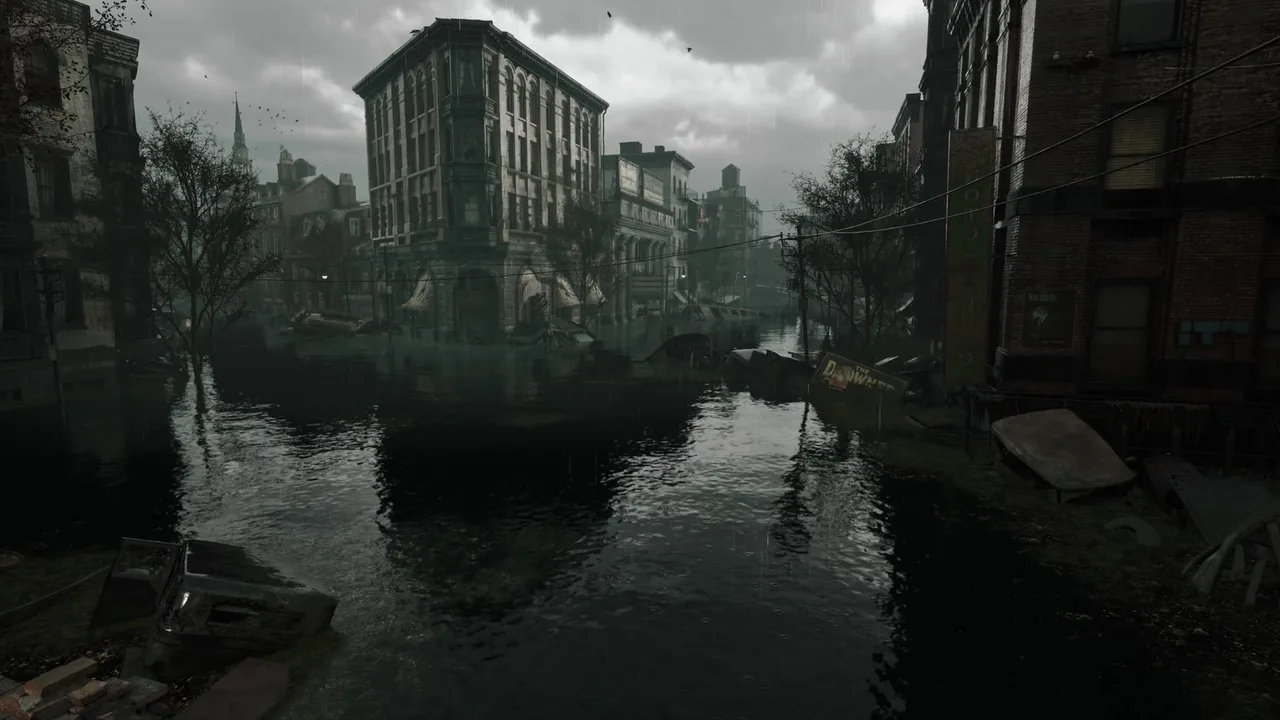
Someone left the porch light on. It's been weeks. The bulb is still burning.
The residential neighborhoods of Arkham were never grand. Clapboard row houses with narrow porches, three-deckers with laundry lines strung between them, the kind of dense New England housing where everyone knew everyone’s business and nobody talked about what happened in the basement. The flood didn’t destroy these homes so much as violate them — filling living rooms with cold, dark water, scattering family photographs across floating debris, turning private spaces into something public and profane.
This is where The Sinking City 2 stops being a monster game and becomes a ghost story.
The Shape of the Neighborhood
The Residential Flats likely sit west of downtown Arkham, spreading along the higher ground that would have been workers’ housing in a 1920s mill town. Row houses and duplexes packed tight, separated by narrow alleys barely wide enough for a car. Small yards, chain-link fences, porches with rocking chairs.
The flood hit unevenly here. Some streets are waist-deep, passable on foot with effort. Others are fully submerged up to the second floor, accessible only by boat or by climbing through upper-story windows from adjacent rooftops. The flood system adds another layer: a block that was navigable on foot this morning might be chest-deep by afternoon, and the route you used to get in is now underwater.
The density is the defining feature. Downtown has big open lobbies and wide streets. The Residential Flats have none of that. Rooms are small. Hallways are narrow. Stairways are steep and dark. If something is waiting behind a closed bedroom door — and something frequently is — you don’t have room to backpedal.
The Personal Horror
Every other district in Arkham tells you about a city that drowned. The Residential Flats tell you about people who drowned.
A child’s bedroom with toys floating in the water. A kitchen table still set for dinner, plates sliding gently in the current. Family photos on a mantelpiece above the waterline, faces smiling out at a room that’s now a fish tank. These aren’t setpieces in the traditional horror game sense — they’re the ambient texture of an entire district, and based on Frogwares’ approach to environmental storytelling in previews, they’ll be relentless.
The sanity system is expected to hit hardest here. The Sinking City 2’s mind pressure mechanic responds to horror, and the Flats are saturated with the quiet, domestic kind — the kind that doesn’t jump out at you but accumulates. You open a door, and there’s a rocking chair moving by itself. You turn a corner, and the hallway is longer than it should be. A mirror reflects a room that doesn’t match the one you’re standing in.
Apparitions — spectral figures, shadows that move wrong, the pale shapes hinted at in promotional screenshots — seem most at home here. That image of the pale figure in the doorway isn’t a creature you fight. It’s something you see, and seeing it costs you.
What’s Behind the Doors
The Flats are a scavenger’s goldmine, if you can stomach the atmosphere. Private homes mean medicine cabinets, gun cabinets, pantry shelves, workshop benches in basements. The kind of mundane supplies that Arkham’s commercial districts may have lost to looting but that residential neighborhoods still hold because nobody wants to go inside these houses.
Locked doors are common. Basements require wading into flooded spaces where visibility drops to nothing. Attics accessed by pull-down ladders offer relative safety and often better loot — people hid their valuables high when the water started rising. You might find ammunition stashed in a shoebox on a closet shelf, or a hand-drawn map tucked into a Bible, marking a route to someplace the resident was trying to reach before the water took them.
The investigation system has a different flavor here than downtown. Instead of institutional records and business ledgers, you find diaries, letters, scrawled notes. Personal testimonies about the flood — when it started, how fast it rose, what people saw in the water. Individually these are heartbreaking. Collectively, they might map the flood’s progression and point you toward its source.
Things in the Walls
Slithers patrol the Flats, but the real threats are subtler. The animated dead feel different here because they used to be residents. A Slither in a warehouse is a monster. A Slither in a bathrobe, in a living room, next to a family photograph, is something else entirely.
The tight interiors change combat math. Firearms are loud and draw attention in a neighborhood where sound carries between thin walls. A gunshot in one house might alert enemies in adjacent buildings. Melee weapons or careful stealth may serve you better, though the narrow hallways make melee risky too — one Slither in a corridor is manageable, two is a problem when you can’t sidestep.
The reality-bending shadows are reportedly more active in the Flats than elsewhere. Rooms that rearrange themselves when you’re not looking. Doors that open onto spaces that shouldn’t exist. The residential architecture becomes a weapon — your spatial memory betrays you, and the familiar geometry of a house (hallway, bedroom, bathroom, stairs) warps into something recursive and wrong.
Why You’d Go
You go because the personal lore matters. The residents’ stories feed the investigation, and the Flats hold pieces of the puzzle that you won’t find in public buildings or commercial districts. Someone who lived here knew something, saw something, wrote it down before the water came.
You go because the supplies are worth the sanity cost, especially early in the game when every bandage and every bullet counts.
And honestly, you go because the Flats are where The Sinking City 2 is likely at its most genuinely frightening. Not the jump-scare kind. The kind that follows you out of the game — the rocking chair, the set table, the porch light still burning. Horror works best when it has something human to destroy, and every house in the Residential Flats had a family inside it once.